

🚨 TRUMP DECLARES “NO SHARIA LAW” IN AMERICA — THE STATEMENT IGNITES A FIERY NATIONAL DEBATE

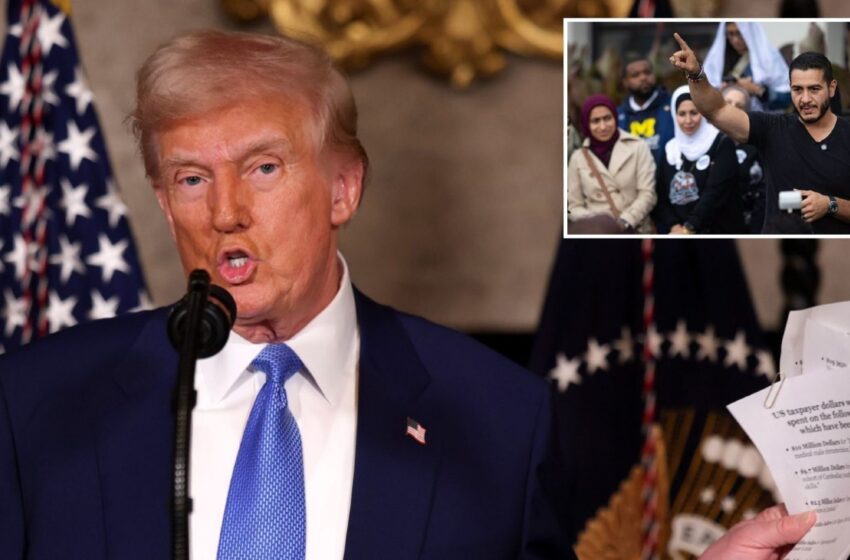
Trump Bombshell Announcement on BANNING Sharia Law — Dems Go Ballistic
President Donald Trump has now put a politically explosive question into unusually direct terms.
Asked whether he would support a federal law barring Sharia law in the United States, Trump said he would “absolutely” support prohibiting it and argued that the country should operate under one legal system.
The remarks came during an August 26, 2026 interview with conservative host Glenn Beck.
Beck asked whether Trump would push for or sign what he called a “no-Sharia law act for America.”
Trump did not hedge.
“On Sharia law, I would absolutely say that’s not this country,” Trump said.
He added that he would “absolutely prohibit the Sharia law thing” and argued that “you have one system.”
Those comments are real.
But what they would mean as actual federal policy is much less simple than the language of the interview suggests.
The United States already has one binding constitutional legal system.
Federal and state courts are governed by the Constitution, statutes, regulations and binding judicial precedent.
Religious rules do not supersede the Constitution.
A church, synagogue, mosque or other religious community may establish rules for its own members.
Individuals may voluntarily organize parts of their private lives around religious principles.
But those practices do not become a parallel sovereign legal system capable of overriding federal or state law.
That distinction is central to understanding the debate now surrounding Trump’s remarks.
The political question is whether Congress should enact an explicit statutory ban aimed at Sharia.
The constitutional question is whether the government can single out one religion’s legal traditions for special prohibition without violating the First Amendment.
Those are not the same issue.
And past litigation suggests that a law written specifically against Islam would face immediate legal challenges.
The clearest example comes from Oklahoma.
In 2010, voters approved State Question 755, a proposed constitutional amendment that would have barred state courts from considering or using Sharia law and international law.
The measure won with roughly 70 percent of the vote.
But it never took effect.
A federal district court blocked certification, and the U.S. Court of Appeals for the Tenth Circuit upheld the preliminary injunction in 2012.
The problem was not that Sharia could override the U.S. Constitution.
It could not.
The problem was that Oklahoma had singled out one faith by name.
The plaintiff, Muneer Awad, argued that the amendment violated the Establishment and Free Exercise Clauses because it treated Islam differently from other religions.
The courts concluded that he had shown a strong likelihood of success on those constitutional claims.
That precedent does not answer every possible version of a federal proposal.
Congress could attempt to write a broader, religion-neutral statute dealing with foreign law, religious arbitration or the protection of constitutional rights.
But a law that simply says “Sharia is banned” would face a very different constitutional problem.
The First Amendment prevents government from establishing religion and protects the free exercise of religion.
The government can regulate conduct through generally applicable laws.
It can punish violence, coercion, fraud, abuse or other illegal behavior regardless of whether someone invokes religion as justification.
What it generally cannot do is prohibit religious belief simply because the belief comes from Islam.
That is why the phrase “ban Sharia law” can mean very different things depending on who is using it.
To some conservatives, it means ensuring that no court applies a religious or foreign rule when doing so would violate American constitutional rights.
That principle is already largely built into the American legal system.
To some critics, however, an explicit Sharia ban sounds like government targeting Islamic religious practice itself.
That is where the First Amendment fight begins.
Trump’s interview did not resolve that ambiguity.
He spoke in broad terms.
He said Sharia was “not this country.”
He claimed there were “pockets” of it in the United States.
He compared the issue to what he described as developments in London and Paris.
And he said that when authorities encounter it, “we take it out.”
But he did not identify a specific federal bill.
He did not define what conduct would qualify as prohibited Sharia.
He did not explain whether the policy would apply only when a religious rule conflicted with U.S. law or whether it would extend to private religious practices that are currently protected.
That missing detail is important.
Sharia is not a single criminal code enforced by one central Islamic authority.
The term broadly refers to Islamic religious and ethical principles derived from religious texts and centuries of legal interpretation.
For individual Muslims, that can include rules concerning prayer, fasting, charitable giving, diet, marriage, finance and other parts of daily life.
Many American Muslims follow aspects of Sharia in the same sense that religious Jews may follow halakha or Catholics may follow canon law in matters of faith.
None of those religious systems displaces U.S. law.
The government can still enforce civil and criminal law.
A religious marriage, for example, does not exempt someone from state marriage requirements.
A religious financial arrangement does not override federal banking or fraud laws.
A religious arbitration agreement can be enforced only to the extent ordinary American contract and arbitration law allows it.
That is why any actual Trump administration proposal would have to answer a basic question.
What exactly is being banned that is not already prohibited?
If the target is an effort to replace the Constitution with a religious government, existing constitutional structures already prevent that.
If the target is private religious observance, a broad ban would face severe constitutional problems.
If the target is courts enforcing foreign or religious rules when those rules violate fundamental rights, lawmakers could potentially draft a religion-neutral safeguard.
The wording would determine the legal fight.
The political fight is already underway.
Trump’s comments came as Sharia had become an issue in the Michigan Senate race.
Democratic nominee Abdul El-Sayed, a Muslim physician and former Detroit health official, has faced repeated Republican attacks over his past statements concerning Sharia and a 2010 Oklahoma ballot measure.
Vice President JD Vance has made El-Sayed one of the most prominent targets of the Republican campaign in Michigan.
Vance has accused him of supporting Sharia law in the United States and argued that El-Sayed believes critics of Sharia are motivated by White supremacy.
The underlying record is more nuanced.
El-Sayed did criticize Oklahoma’s anti-Sharia measure during a 2022 speech at a Council on American-Islamic Relations banquet.
He connected that measure to a broader argument about discrimination against minority groups and said a Sharia ban could not be understood without considering the history of White supremacy.
Those remarks are real.
But they are not the same as calling for Sharia to become the law of the United States.
PolitiFact reviewed the 2022 speech in August 2026 and concluded that Republican claims that El-Sayed had openly called for implementing Sharia in the United States distorted what he said.
El-Sayed’s own explanation has been straightforward.
During an August 2026 Fox News interview, he compared Sharia to Christian canon law and said nobody was trying to impose Sharia on other Americans.
His argument was that Americans should be free to practice their religion privately while remaining subject to the same civil law as everyone else.
That distinction is important because El-Sayed has also described himself in the past as personally obligated to follow Sharia-compliant practices.
In a 2009 New York Times interview, for example, he discussed choosing a Sharia-compliant mortgage because of his religious beliefs.
Republicans have cited that statement as evidence that Sharia plays an important role in his life.
It does.
But private religious observance is different from advocating that the government impose religious law on the public.
A candidate can personally follow Catholic canon law, Orthodox Jewish law or Islamic religious rules without proposing to replace the Constitution.
The political argument now depends heavily on whether voters accept that distinction.
Vance has generally framed the issue differently.
He has portrayed El-Sayed’s criticism of anti-Sharia legislation as evidence that the Democratic Party has moved outside the cultural mainstream.
During an August 21 speech, Vance told supporters that El-Sayed had argued that criticism of Sharia was rooted in White supremacy.
Vance then went further, suggesting that El-Sayed believed the country “should have Sharia law.”
That last characterization is where the dispute becomes factual rather than ideological.
The record supports saying El-Sayed opposed a Sharia-specific ban.
It supports saying he personally follows Islamic religious principles.
It supports saying he connected anti-Sharia politics to White supremacy.
It does not clearly support the claim that he called for Sharia to replace American law.
That matters because Trump’s new comments could turn a candidate-specific attack into a national policy debate.
For years, anti-Sharia proposals have periodically surfaced in state legislatures.
Supporters have generally described them as safeguards against foreign or religious rules being used to undermine constitutional protections.
Opponents have argued that explicit references to Sharia unnecessarily single out Muslims when American courts are already required to follow American law.
The Oklahoma case demonstrated the constitutional danger of writing the religious target directly into the law.
A federal proposal would face the same basic problem, but at a much larger scale.
The Supreme Court has repeatedly treated laws targeting religious belief or discriminating among faiths as constitutionally suspect.
Government has broad power to regulate conduct through neutral laws.
It has much less power to declare that one religion’s beliefs are forbidden.
That means the administration would have to distinguish between preventing an alternative government legal system and prohibiting ordinary religious observance.
The first goal is largely consistent with existing constitutional principles.
The second would be extraordinarily difficult to defend.
There is also a practical question.
Trump said there are “pockets” of Sharia in the United States.
He did not explain what he meant.
American courts sometimes encounter religious principles because citizens bring disputes involving religious contracts, marriages, wills or arbitration agreements.
That does not mean those courts are subordinating American law to Sharia.
A court can consider the terms of a private agreement while still applying state contract law.
Similarly, courts have sometimes enforced decisions or agreements produced through Jewish religious arbitration or Christian dispute-resolution systems when ordinary secular law permits them to do so.
The government’s role is not to determine whether a religion’s theology is correct.
Its role is to enforce neutral legal rules.
That distinction would become critical if Congress tried to translate Trump’s remarks into legislation.
A narrowly written bill could focus on protecting constitutional rights regardless of the source of any competing rule.
For example, lawmakers could say that no foreign or religious law may be enforced when doing so would violate a constitutional right or a fundamental public policy of the state or federal government.
That approach would avoid naming Islam.
A law aimed only at Sharia would be much more vulnerable.
The political advantage of the narrower language, however, might also be its political weakness.
Trump’s remarks were powerful precisely because they were not technical.
“There’s no Sharia law.”
“You have one system.”
Those phrases draw a clear cultural line.
They are easy to communicate.
They are much harder to turn into constitutional statutory language.
That is the tension now facing any Republican who wants to turn the president’s comments into federal law.
The party can campaign on the idea that American constitutional law must remain supreme.
Very few voters dispute that principle.
But Congress would then have to identify an actual legal problem that existing law does not already solve.
It would also have to draft a remedy that does not punish Muslims for practicing their faith.
Democrats and civil-liberties groups would almost certainly focus on that distinction.
The headline that Democrats have “gone ballistic” is stronger than the public evidence available so far.
There has been significant criticism of Republican attacks on El-Sayed, and El-Sayed himself has accused the Trump administration and Republican leaders of targeting him because he is Muslim.
But there is not yet evidence of one unified Democratic response to Trump’s August 26 comments.
The more accurate description is that Trump has intensified an argument already active in the Michigan Senate race and potentially pushed it onto the national stage.
That is politically significant on its own.
Michigan is one of the most closely watched Senate contests of the 2026 midterms.
El-Sayed is running against Republican Mike Rogers.
Reuters has identified Michigan as one of the races that could help decide control of the chamber.
That gives Republicans a strong incentive to make El-Sayed’s ideological and religious views part of the campaign.
It gives Democrats an equally strong incentive to frame attacks on his faith as religious discrimination.
The debate therefore operates on two levels.
At the campaign level, Republicans want voters to associate El-Sayed with an unfamiliar and potentially threatening legal concept.
El-Sayed wants voters to see the attack as an attempt to turn his Muslim faith into evidence against him.
At the constitutional level, the issue is narrower.
The United States already has one supreme constitutional legal order.
Religious practice remains protected until it conflicts with generally applicable law.
Government may punish illegal conduct regardless of religious motivation.
But government cannot simply outlaw a religion’s beliefs because it dislikes them.
Trump’s interview does not yet amount to legislation.
There is no publicly released White House bill defining a federal Sharia prohibition.
There is no enacted ban.
There is no new executive order establishing one.
What exists is a clear statement of presidential support for the concept.
That is enough to make the issue politically important.
It is not enough to know what the eventual law would look like.
That distinction should remain at the center of the story.
Trump said he would “absolutely prohibit” Sharia law.
The quotation is real.
His argument that America should have one legal system reflects an uncontested constitutional principle.
But whether Congress can enact a law specifically called a Sharia ban depends entirely on what the law actually prohibits.
If it merely restates that the Constitution and American law control, it may do little that existing law does not already accomplish.
If it targets private Islamic religious observance, it would face serious First Amendment problems.
If it is written neutrally to prevent any religious or foreign rule from overriding constitutional rights, it becomes a different proposal from a ban aimed specifically at Islam.
Those distinctions may sound legalistic.